When to Move From Compliance to Proactive Tax Strategy
For many founders, the relationship with their CPA boils down to a recurring annual ritual: gather the previous year's receipts, hand over a spreadsheet, and wait to see how much money is owed to the government. This is the world of traditional tax compliance. It is backward-looking, transactional, and focused entirely on the bare minimum—making sure you check the right boxes to avoid an audit.
But as a high-growth company scales past its first million in revenue, this passive approach transitions from a minor operational gap into a compounding financial leak.
If your financial team only tells you how much tax you owe in March or April, they are looking through the rearview mirror. By the time you file your return, the window for meaningful savings has closed. To build real corporate value, leaders must recognize the critical inflection points that signal it’s time to pivot from basic compliance to a proactive tax mitigation strategy.
Understanding the Tax Strategy Maturity Curve
To successfully make the shift, you must first understand where your business currently sits on the financial maturity curve.
Level 1: Basic Compliance (The Rearview Mirror): This level focuses on accurate data entry, historical logging, and meeting IRS deadlines. It answers the question, "What did we do last year?"
Level 2: Active Tax Mitigation (The Windshield): This level introduces year-round positioning, optimization of entity structures, and timing cash flows to minimize liabilities. It answers the question, "What are we doing right now to save money?"
Level 3: Strategic Valuation Synergy (The Horizon): The highest tier of planning, where every tax decision is designed to protect your capital stack, secure non-dilutive funding, and maximize your market valuation multiplier ahead of an exit or funding round.
The Core Trigger Points: When Compliance is No Longer Enough
Relying on a generalist, compliance-only accountant becomes genuinely dangerous when your business encounters specific "trigger points" of operational complexity. If your business is experiencing any of the following four milestones, the compliance model is actively costing you money.
1. You Cross the $1M Revenue Threshold (The Scale Trigger)
When you are a small startup, simple cash-basis bookkeeping is sufficient. However, crossing seven figures in revenue introduces complex structural demands. At this stage, your entity structure (e.g., LLC vs. S-Corp vs. C-Corp) must be audited against your three-year growth plan to prevent structural cash leaks. Furthermore, managing high-volume transactions without a forward-looking strategy can accidentally push you into higher tax brackets without the corresponding cash flow to support it.
2. You’re Scaling a Recurring Revenue Model (The ASC 606 Trigger)
For software-as-a-service (SaaS) and technology companies, growth brings specialized accounting hurdles. Straining to fit subscription tiers, deferred revenues, and multi-year enterprise contracts into standard tax software creates immediate friction. Transitioning to a proactive strategy allows you to build a scalable ASC 606 infrastructure that complies with GAAP standards while aligning your tax timing to keep more cash inside the business.
3. Your Operations Revolve Around Innovation (The R&D Credit Trigger)
Pharma, life sciences, and tech firms routinely leave six figures on the table because generalist CPAs fail to properly capture specialized credits. Proactive tax strategy evaluates your technical payroll and operational spend in real time to leverage Research & Development (R&D) Tax Credits. For early-commercial stage or pre-revenue biotech firms, these credits serve as vital, non-dilutive funding that can be used to offset payroll taxes long before the company turns a commercial profit.
4. You Are Preparing for an Equity Raise or Exit (The Valuation Trigger)
Whether you just secured a fresh Seed or Series A capital injection or are mapping out an acquisition pathway, your financial records will soon face institutional-grade due diligence. Compliance-only accounting cleanly exports past balance sheets and P&L statements. Proactive strategy, however, cleans up owner’s discretionary earnings, utilizes advanced tax structures like Section 1202 Qualified Small Business Stock (QSBS) to target capital gains exclusions, and documents aggressive positions well in advance to prevent friction during investor audits.
From Cost Center to Profit Center: The Strategic Framework
When you view tax preparation as a transactional compliance burden, it is categorized purely as an expense. Moving to an active advisory model transforms your financial stack into a profit driver.
Consider how the two approaches handle common high-growth challenges:
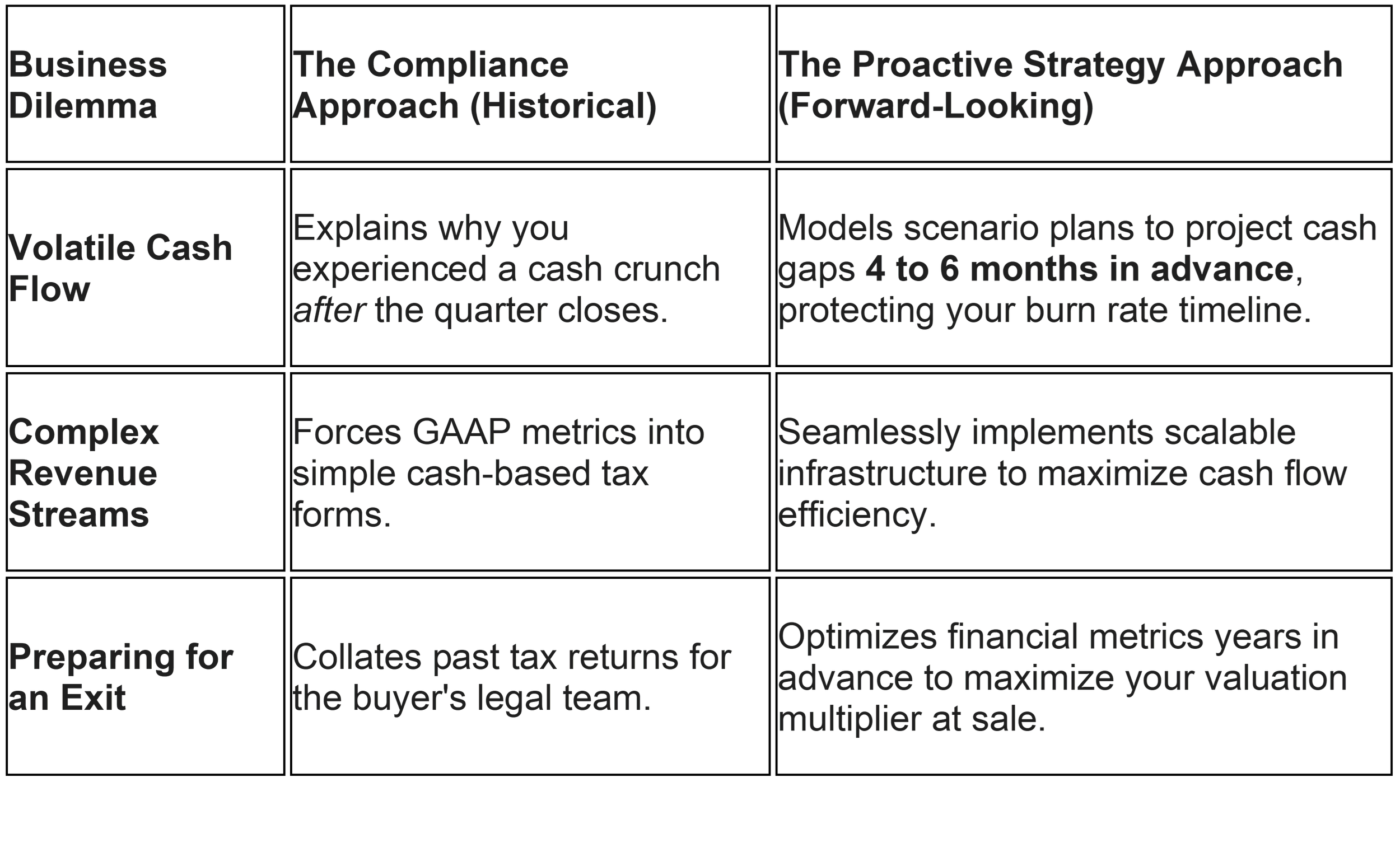
Stop Looking Backward
If your business is scaling rapidly, navigating specialized compliance laws, or managing complex cap tables, continuing to operate in a seasonal, reactive vacuum is a liability.
It is time to stop treating your financial team like historians. By pivoting to proactive tax mitigation and strategic financial leadership, you insulate your company from risk, lower your cost of capital, and systematically build a more valuable enterprise. Schedule a customized Financial Health & Venture-Readiness Assessment today. We’ll help you locate structural cash leaks, map your true burn rate timeline, and prime your financial stack for its next scaling phase.